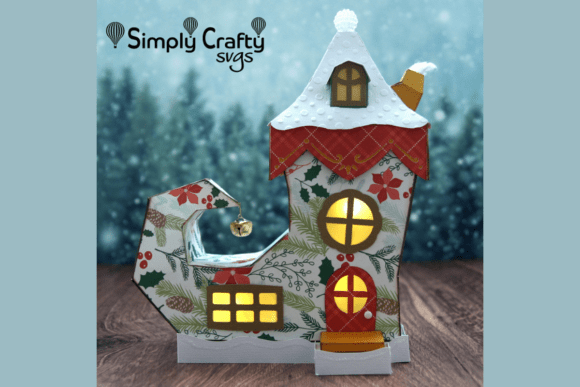
Elf House SVG: 3D SVG for Festive 3D Houses
When evaluating a new graphic design asset for a seasonal client campaign, my first criterion is always versatility mixed with distinct character. As a professional designer managing branding and packaging for small businesses, I recently tested the Elf House SVG to determine if it could anchor a holiday collection for a boutique handmade brand. The immediate impression of this file is one of structured whimsy. Unlike flat vector art that can sometimes feel sterile or overly corporate, this asset carries the tactile promise of paper crafting. It captures the essence of "Whimsical Holiday Magic" without descending into chaotic clutter. The silhouette, shaped distinctly like an elf shoe, offers a unique architectural form that stands out in a marketplace saturated with generic gingerbread houses and standard cottages. For a designer, this specific shape provides a narrative hook; it tells a story of folklore and tradition before a single word of copy is read.
Elevating Brand Identity and Packaging Concepts
In a real-world project scenario, I utilized this Elf House SVG as the centerpiece for a limited-edition holiday gift box line. The primary challenge was creating packaging design that felt premium yet accessible. This 3D SVG proved invaluable because its geometry allows for depth perception even when rendered in 2D marketing visuals. When applied to product labels and box sleeves, the intricate lines of the elf shoe structure created a sense of craftsmanship that aligned perfectly with the client’s handmade business ethos. For brand identity work, this asset functions exceptionally well as a seasonal logo lockup element or a recurring motif across a design bundle. It bridges the gap between playful illustration and structural design, making it suitable for brands that want to evoke nostalgia while maintaining a polished, modern aesthetic. The visual weight of the house balances beautifully against negative space, allowing for elegant typography placement that doesn't compete for attention.
Strategic Applications Across Digital and Print Media
Versatility is non-negotiable for commercial design assets. During my review, I tested the Elf House SVG across multiple touchpoints relevant to content creators and digital sellers. For social media graphics, specifically Instagram carousels and Pinterest pins, the asset serves as an excellent frame or focal point. Its verticality complements mobile-first layouts, guiding the viewer's eye through the content naturally. In the realm of print-on-demand merchandise, such as t-shirt design and tote bags, the detailed line work holds up remarkably well at larger scales. However, its true strength lies in Cricut project applications and paper crafting. Because it is designed as a 3D construct, the cut lines are logical and assembly-friendly, which is a critical consideration for designers selling printable design files or physical kits on platforms like Etsy. For editorial design and blog visuals, using this asset as a header graphic instantly communicates the article's festive theme while adding a layer of professional polish that stock photography often lacks.
Navigating Visual Hierarchy and Layout Constraints
While the Elf House SVG is a powerful tool, professional judgment requires knowing where not to use it. In my testing, I found that this asset demands breathing room. It performs poorly in crowded layouts or when scaled down to favicon sizes. The complexity of the 3D folds and the specific shoe shape lose definition below two inches in width, turning into visual noise rather than a recognizable icon. Designers should avoid placing this asset against busy photographic backgrounds or complex patterns unless there is significant contrast or a solid backing element. It is also ill-suited for minimalist corporate branding or luxury sectors where clean, abstract geometry is preferred over illustrative charm. When integrating this into a Canva template or web banner, ensure it acts as a hero element or a deliberate accent. If the layout already contains heavy textures or multiple competing illustrations, this asset will fight for dominance, disrupting the visual hierarchy and reducing overall readability. Reserve it for moments where you need to inject warmth and specific thematic signaling.
Technical Pre-Flight Checks for Commercial Success
Before committing this Elf House SVG to a final client deliverable, a rigorous technical review is essential. My standard protocol for any SVG design includes testing in pure black and white to verify that the form relies on shape rather than color dependency. I strongly recommend previewing the file at both maximum print size and minimum digital size to check for node integrity and stroke consistency. If you are incorporating this into a sublimation design or sticker design, inspect the PNG transparency and edge quality closely; jagged edges on curved paper folds can ruin the illusion of 3D depth. Typography pairing is equally critical. This asset harmonizes best with textured serif fonts or organic handwritten scripts that mirror its artisanal quality. Avoid rigid geometric sans-serifs, which can create a stylistic clash. Furthermore, always verify the commercial license terms before using this in a creative marketplace listing or client branding package. Understanding whether you can modify the vector points or resell the derivative work protects your business and ensures ethical usage. Finally, test print the actual 3D assembly if the project involves physical construction; screen accuracy does not always translate to paper scoring and folding precision.
The Verdict on Festive Design Utility
Ultimately, the Elf House SVG earns its place in a professional designer’s toolkit by offering a specific emotional resonance backed by functional geometry. It is more than just clipart; it is a structural component for building immersive holiday experiences. For marketers and small business owners, it provides a shortcut to establishing a festive mood that feels authentic rather than manufactured. For crafters and digital sellers, it offers a reliable foundation for products that customers actually want to build and display. By respecting its spatial requirements and pairing it with complementary typographic elements, this asset can elevate a seasonal campaign from generic to memorable. It successfully translates the concept of whimsical holiday magic into a tangible, usable format that supports both creative expression and commercial objectives. When used with intention and technical care, it transforms standard holiday collateral into something that invites interaction and sparks genuine delight.